Bedding · Buying guide
What to Look for in an Organic Crib Mattress: A Practical Buying Guide
A crib mattress is a small landscape with a serious job: it must fit the crib, provide a firm, flat surface, and stand up to everyday care. Organic materials may matter to your family, but a label alone cannot answer the most important questions. Here is how to compare construction, certifications, fit, firmness, waterproofing, and care—while keeping safe-sleep guidance at the center of the decision.
Shopping for a baby’s mattress can feel like entering a thicket of claims. Product descriptions may use words such as organic, natural, chemical-free, or non-toxic alongside lists of fibers, foams, coatings, and certifications. Some terms refer to specific, verifiable standards; others are broad marketing language. The clearest route through the noise is to begin with the basics: a snug fit in the crib, a firm and flat sleep surface, and a construction you can understand and care for.
Organic crib mattresses are not a separate category of safe-sleep rules. Whatever its materials or price, a mattress should be used according to current safe-sleep guidance and the instructions supplied with the crib and mattress. The aim of this guide is to help you assess a product’s claims and practical features—not to suggest that a particular material or certification can guarantee health outcomes.
Begin with fit: the mattress must suit the crib
Fit is not a decorative detail. A mattress that is too small can leave gaps between its edges and the crib frame; one that is too large may bow, buckle, or fail to sit flat. Before comparing organic materials, identify the crib model and the mattress dimensions specified by its manufacturer. Check the mattress label and product documentation, and follow any instructions that explain how to assess the fit.
Once the mattress is in place, make sure it lies flat and does not shift around in the frame. Check all sides and corners rather than judging by one edge alone. If you are unsure whether the fit is correct, consult the crib manufacturer rather than relying on a general size chart or a visual guess. A product described as “standard size” still needs to match the specific crib and its instructions.
- Confirm the crib’s required mattress size before purchasing.
- Check that the mattress sits level and securely within the frame.
- Inspect the perimeter for gaps or areas where the mattress does not fit as directed.
- Recheck fit after adding an approved mattress cover or protector, if used.
Fit is also worth checking again when a crib is assembled, moved, or converted between configurations. Save the care guide and product details so that you can confirm the mattress is being used as intended. If any component changes how the mattress sits or prevents it from lying flat, stop and seek guidance from the crib or mattress manufacturer.
Firmness and a flat surface come first
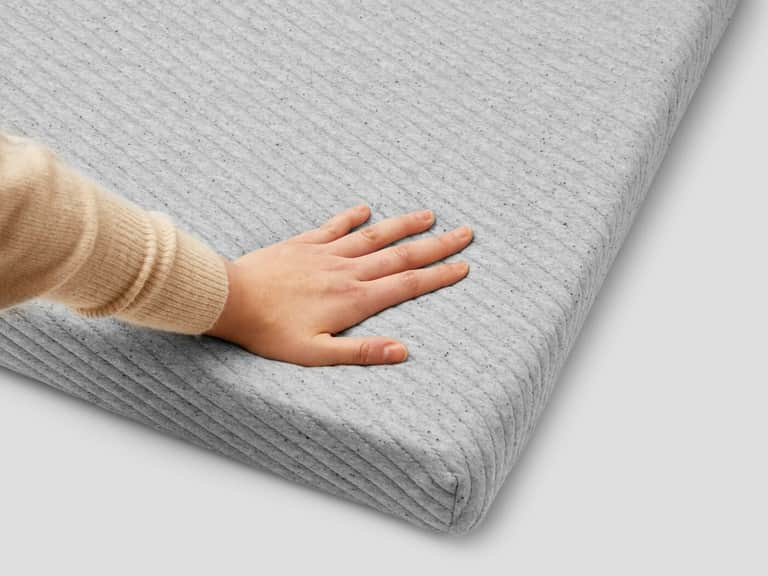
A crib mattress should provide a firm, flat sleep surface. A softer surface may feel inviting to an adult hand, but softness is not the measure to use when choosing a mattress for an infant. Avoid selecting a product because it feels plush, contours deeply, or resembles an adult mattress designed for pressure relief. Follow the current safe-sleep recommendations of recognized public-health authorities, as well as the directions that came with the crib.
Terms such as firm can be used inconsistently in retail copy, so look beyond an isolated adjective. Read the manufacturer’s description of the construction and intended use, check that the product is specifically designed for a crib, and look for clear instructions about the surfaces and configurations available. Some mattresses have two sides intended for different stages. If so, use each side only as directed, and do not assume that a reversible design means either side is suitable at any time.
A mattress should remain flat and structurally sound during use. A pronounced dip, damaged seam, loose component, or surface that no longer lies as intended is a reason to contact the manufacturer and review its guidance. Do not try to make an unsuitable surface firmer by adding objects, extra padding, or improvised layers. Safe-sleep practices should be followed consistently, regardless of whether a mattress is organic, conventional, foam, or fiber-filled.
What does “organic” actually mean?
The word organic can describe a particular fiber, a component, or—in some cases—a product certified under a defined standard. Those are not interchangeable claims. A mattress may contain organic cotton in its cover while other layers have a different composition. A product description may also use “organic” in a brand or collection name without making clear which parts are certified.
Look for precise answers. Which material is described as organic? Does the claim apply to the cover, the filling, or the whole product? Which organization issued the certification, and what does that certification verify? Is there a certificate number or documentation that can be checked? A standard may address the way a fiber is produced, the processing of a textile, or chemical criteria for a finished material. The exact scope depends on the certification; one seal should not be treated as proof of every possible claim about a mattress.
A useful product page explains its materials in a layer-by-layer way. It identifies the cover fabric, inner filling or core, waterproof layer if present, and any adhesives or coatings when applicable. If information is missing, ask the manufacturer for the complete material description and documentation supporting the claim. Clear answers are more useful than strings of reassuring adjectives.
Questions to ask about a certification
- What specific material or manufacturing process does the certification cover?
- Does it apply to the entire mattress or only to one component?
- Who issued it, and can the certification be independently verified?
- Does the product documentation distinguish certified materials from other materials?
Be cautious with phrases such as chemical-free. All physical materials are made of chemicals, so the phrase is not a useful description by itself. Likewise, “natural” does not automatically tell you how a material was processed or whether it meets a particular standard. A credible claim is specific, limited to what the evidence supports, and accompanied by enough information for a buyer to check it.
Compare materials and construction, not just the cover
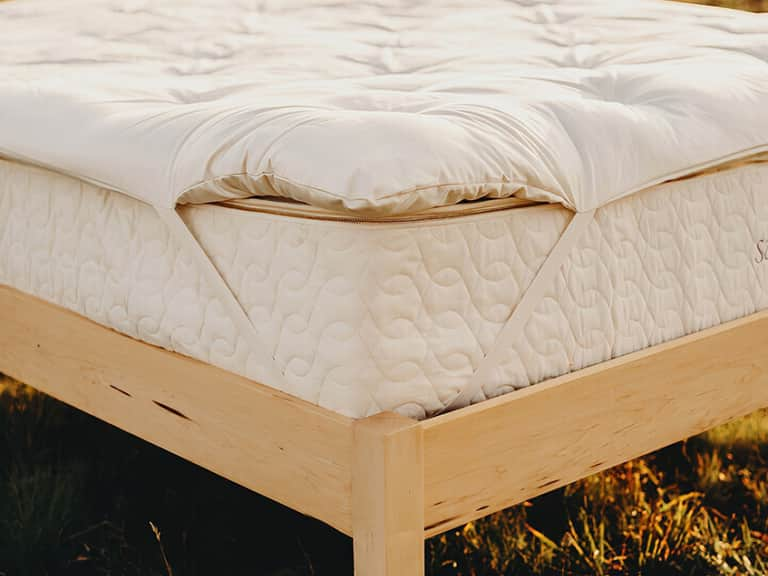
The cover is the part you can see and touch, but the interior determines much of a mattress’s structure. Crib mattresses may use different combinations of foam, fibers, springs, or other materials. There is no single construction that should be assumed to be right for every household. What matters in a comparison is whether the manufacturer clearly describes the materials, explains how the mattress is intended to be used, and provides dependable care and safety information.
A cotton cover, for example, tells you something about the surface fabric; it does not, on its own, establish the composition of the mattress core. A wool or plant-fiber component likewise should be assessed as one part of a complete construction. If you have questions about a material, ask for its location in the mattress, its function, and the documentation behind any environmental or health-related statement.
Construction affects more than the words on a label. It can influence the mattress’s weight, how it is handled during sheet changes, what cleaning methods are allowed, and whether the item can be used on both sides. Avoid assuming that a heavier mattress is safer or more durable, or that a particular natural filling necessarily performs better than another material. Compare documented specifications and instructions rather than relying on a single feature.
Waterproofing, moisture, and everyday cleaning
Babies’ sleep spaces encounter spills, leaks, and routine messes. A wipe-clean or waterproof surface may simplify care, while a non-waterproof textile may require different cleaning and drying steps. Waterproofing can be part of the mattress itself or provided through a separate product. Read the instructions for the exact model you are considering and make sure any additional layer is permitted by the crib and mattress manufacturers.
Ask what creates the water-resistant barrier and where it sits in the construction. If a product uses a coating or membrane, the manufacturer should be able to identify it clearly. “Breathable” is another word that can be used broadly; it is not a substitute for understanding the materials or following safe-sleep guidance. Do not add a topper, pad, pillow, or other soft item to change the feel of the surface unless the relevant manufacturers’ instructions and current guidance explicitly allow it.
Care directions are part of the buying decision. Some mattress covers are removable; others are not designed to be taken off. Some surfaces can be wiped, while others require particular cleaning products or drying times. A cover that looks washable is not necessarily machine washable. Check how to deal with ordinary spills, whether the mattress must be completely dry before use, and whether cleaning could affect a certification, warranty, or waterproof layer.
- Read the complete cleaning instructions before purchase.
- Confirm whether the cover is removable and whether it can be washed.
- Use only cleaning methods the manufacturer permits.
- Check whether a separate protector is compatible with the mattress and crib.
- Inspect the surface after cleaning and allow it to dry as directed.
Durability, warranty, and practical handling
A crib mattress is handled repeatedly: it may need to be lifted for sheet changes, cleaned after a spill, or stored between uses. Weight, handles, and the ability to wipe down its surface can affect how manageable it is in day-to-day life. These features are practical, not a substitute for safe construction. Check that handles, if provided, are intended for handling the mattress and that no component is loose or damaged.
Review the warranty before buying. Note its length, what defects it covers, how to make a claim, and what actions could void coverage. A warranty does not certify that a mattress is organic or guarantee a particular outcome; it describes the manufacturer’s stated obligations under specified conditions. Keep the receipt, care guide, model information, and any certification documents together.
If you expect to use the mattress for another child, ask how the manufacturer recommends inspecting and storing it. Reuse should not be based only on a mattress’s age or appearance. Its condition, fit, history, and the instructions for the specific model all matter. A damaged or altered mattress should not be treated as serviceable simply because it was once suitable.
How to compare products without getting lost in claims
Set a short list of requirements before browsing. Start with the crib’s exact specifications, then decide which material documentation, cleaning features, and budget limits matter to your household. This keeps an appealing label or an elaborate feature list from distracting from fit and safe use.
| What to compare | What to verify |
|---|---|
| Fit | Dimensions and compatibility with the specific crib; instructions for checking the fit. |
| Sleep surface | That the mattress is intended for a crib and provides the firm, flat surface described in its instructions. |
| Organic claims | Which materials are certified, the scope of the certification, and whether documents can be verified. |
| Construction | Clear descriptions of the cover, core or filling, coatings, and any waterproof layer. |
| Care | Approved cleaning methods, drying directions, and whether the cover is removable or washable. |
| Support | Warranty terms, manufacturer contact details, and instructions for damage or product questions. |
If a retailer’s description is shorter than the manufacturer’s documentation, use the manufacturer’s materials for details. If the information still does not answer a basic question—such as what the waterproof barrier is made of or which layer is certified—contact the company. You do not need to become a materials scientist to shop carefully; you do need enough clarity to understand what you are buying.
A simple pre-purchase checklist
Before placing an order, pause for a final review. The following checklist turns a crowded product page into a few practical decisions:
- I have checked the crib’s mattress requirements and dimensions.
- The mattress is specifically described as suitable for the crib and its intended use.
- I understand the construction and can distinguish the cover from the interior materials.
- Any organic or other certification claim identifies what it covers and who verifies it.
- I have read the cleaning, drying, and storage instructions.
- I understand whether waterproofing is built in or supplied by a separate layer.
- I have reviewed warranty terms and know how to contact the manufacturer.
The safest choice is an informed one
An organic crib mattress can appeal to families who want to understand the origin and processing of the materials in a baby’s sleep space. That interest is reasonable, but it should sit alongside—never in place of—the fundamentals. The mattress must fit the crib as directed, provide a firm and flat surface, and be used according to current safe-sleep guidance and the manufacturer’s instructions.
Look for evidence rather than atmosphere: a specific fiber claim, an identifiable certification, a transparent construction description, and care directions that make sense for your household. Ask direct questions when the answers are missing. The best buying decision is not necessarily the one with the most impressive vocabulary or the longest list of features. It is the one you can understand, verify, and use as intended.
In the quiet geometry of a nursery, the mattress is easy to overlook once it is covered by a fitted sheet. Yet beneath that simple surface are decisions about fit, materials, cleaning, and construction. Taking time to examine those details can help families choose with greater confidence—and keep the essentials of a safe sleep space firmly in view.